If corporate travel accounts are on your radar, the right limo software can mean the difference between landing a $50,000 annual contract and losing it to a competitor who answers faster.
The Tuesday Morning That Cost You a Corporate Account
It’s 2:14 a.m. A travel coordinator at a mid-size firm in the local area sends a booking request for 22 airport transfers over the next six weeks. By 8:00 a.m., your competitor has already confirmed the job. You see the email at 7:45 a.m. after dropping a client at the airport. The account is gone before your first cup of coffee.
This is not a rare situation. Corporate travel buyers move fast, often book outside business hours, and have zero patience for phone tag. If you are running a black-car or chauffeur service and still taking bookings by text and voicemail, limo software corporate travel fleet managers rely on is the gap between you and that contract.
This guide breaks down what that gap actually costs, how to close it, and what tools make the biggest difference in the local area market.

What Does a Missed Corporate Booking Actually Cost a Fleet Manager?
A single corporate airport transfer in most regional markets runs between $90 and $180 depending on distance and vehicle class. A recurring corporate account with 3 to 5 weekly runs is worth $15,000 to $40,000 per year in gross revenue. Losing one because your booking process was slow is not a small miss.
A recurring corporate account with 3 to 5 weekly runs is worth $15,000 to $40,000 per year in gross revenue.
Here is how the math stacks up across common job types in the local area:
| Job Type | Typical Market Range | Booking Window | Repeat Potential |
|---|---|---|---|
| Airport Transfer (sedan/SUV) | $90 – $180 | Same day to 48 hrs | High (weekly) |
| Corporate Hourly Charter | $120 – $200/hr, 3-hr minimum | 3 – 14 days | Medium (monthly) |
| Group Airport Shuttle | $250 – $600 | 1 – 7 days | Medium (quarterly) |
| Holiday Party / Event Bus | $800 – $2,500 | 2 – 8 weeks | Annual |
Beyond missed revenue, consider the owner hours burned on manual work. Operators in the local area who still quote by phone typically spend 8 to 12 hours per week on calls, follow-ups, and invoice chasing. At a conservative $50 per hour opportunity cost, that is $400 to $600 per week in time that could go toward driving, marketing, or sleep.
No-shows and chargebacks add another layer. Corporate clients with a card-on-file (a payment method stored securely at booking so you can charge without a second call) have a no-show rate under 5 percent in most markets. Clients booked by phone with no card captured run closer to 12 to 18 percent no-show rates, based on patterns reported across the limousine industry.
Rideshare competition is real too. Uber Black operates in most metro areas and offers corporate accounts a direct billing portal. The only way a local operator competes is with better service AND a booking experience that is just as easy.
How Do Larger Fleets Use Limo Software for Corporate Travel Fleet Managers?
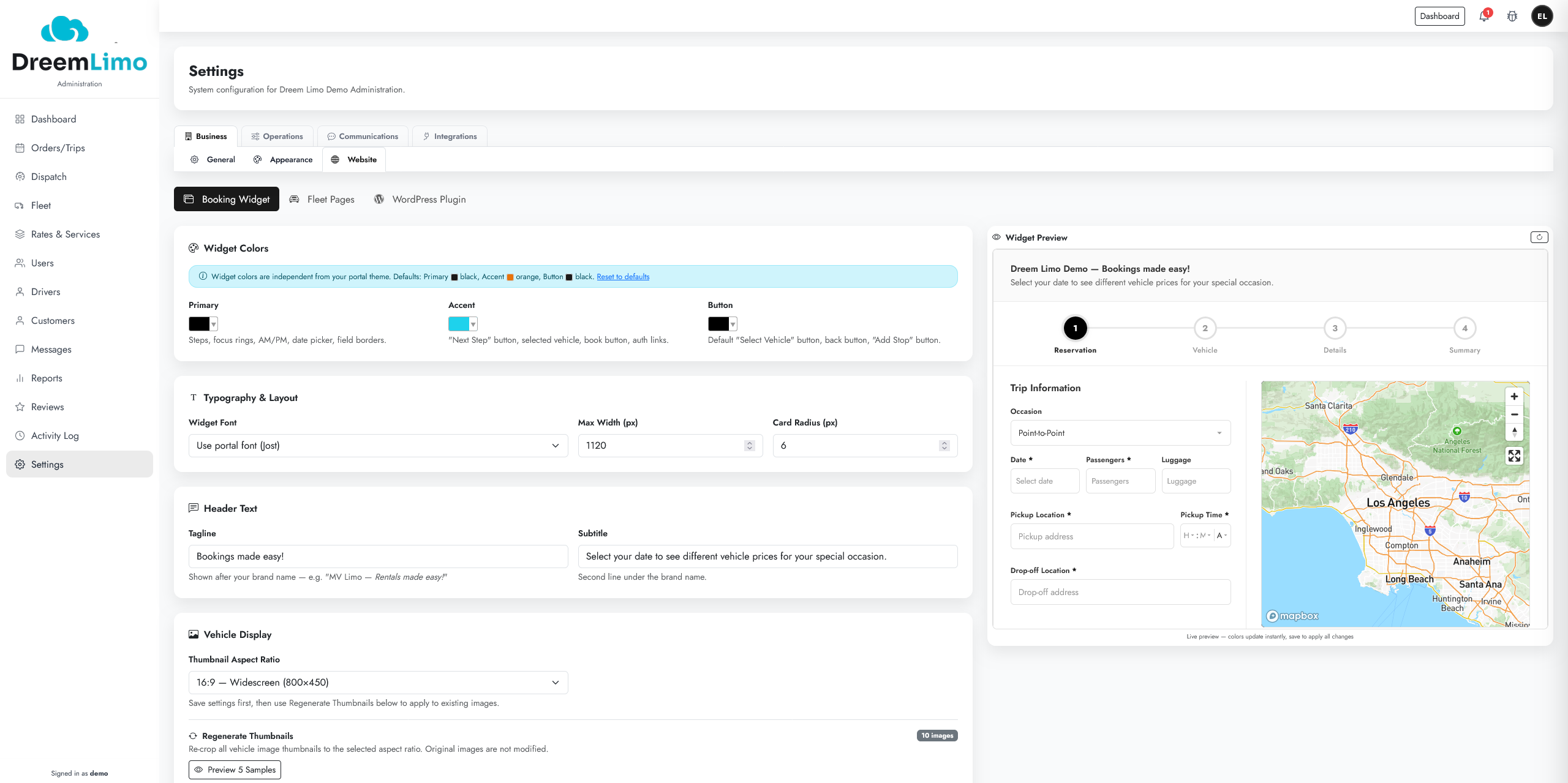
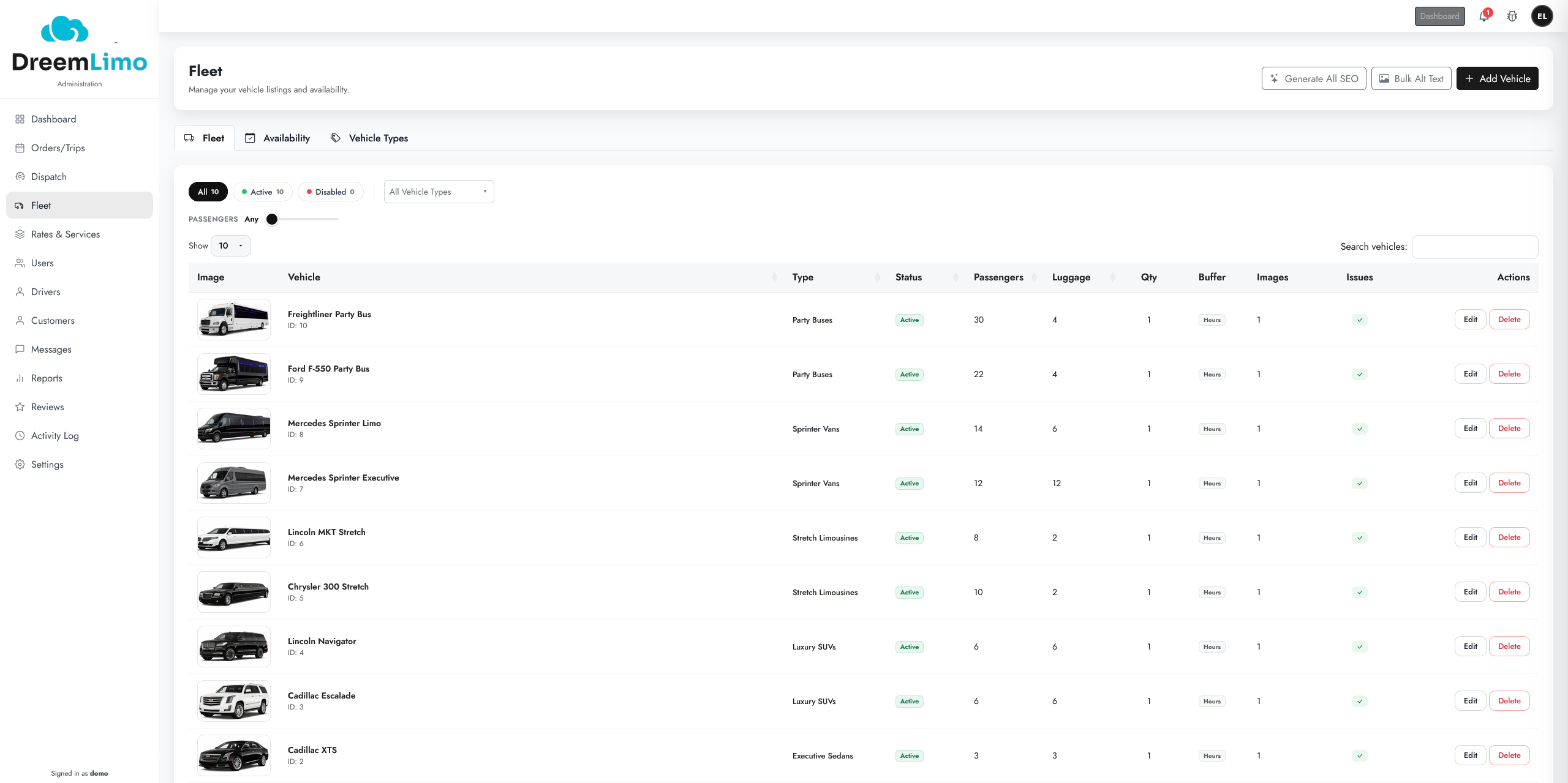
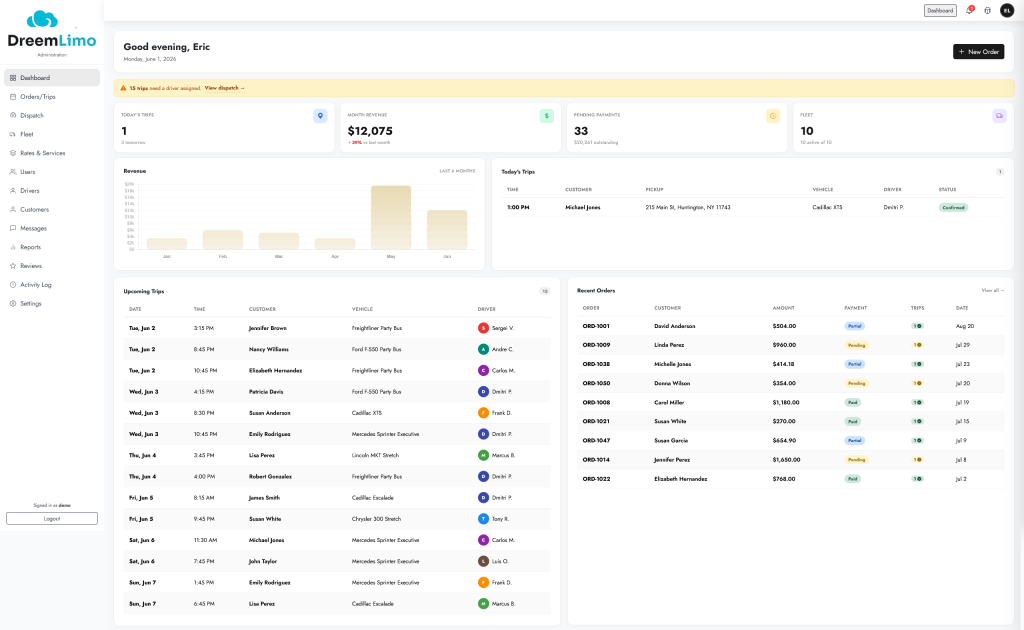
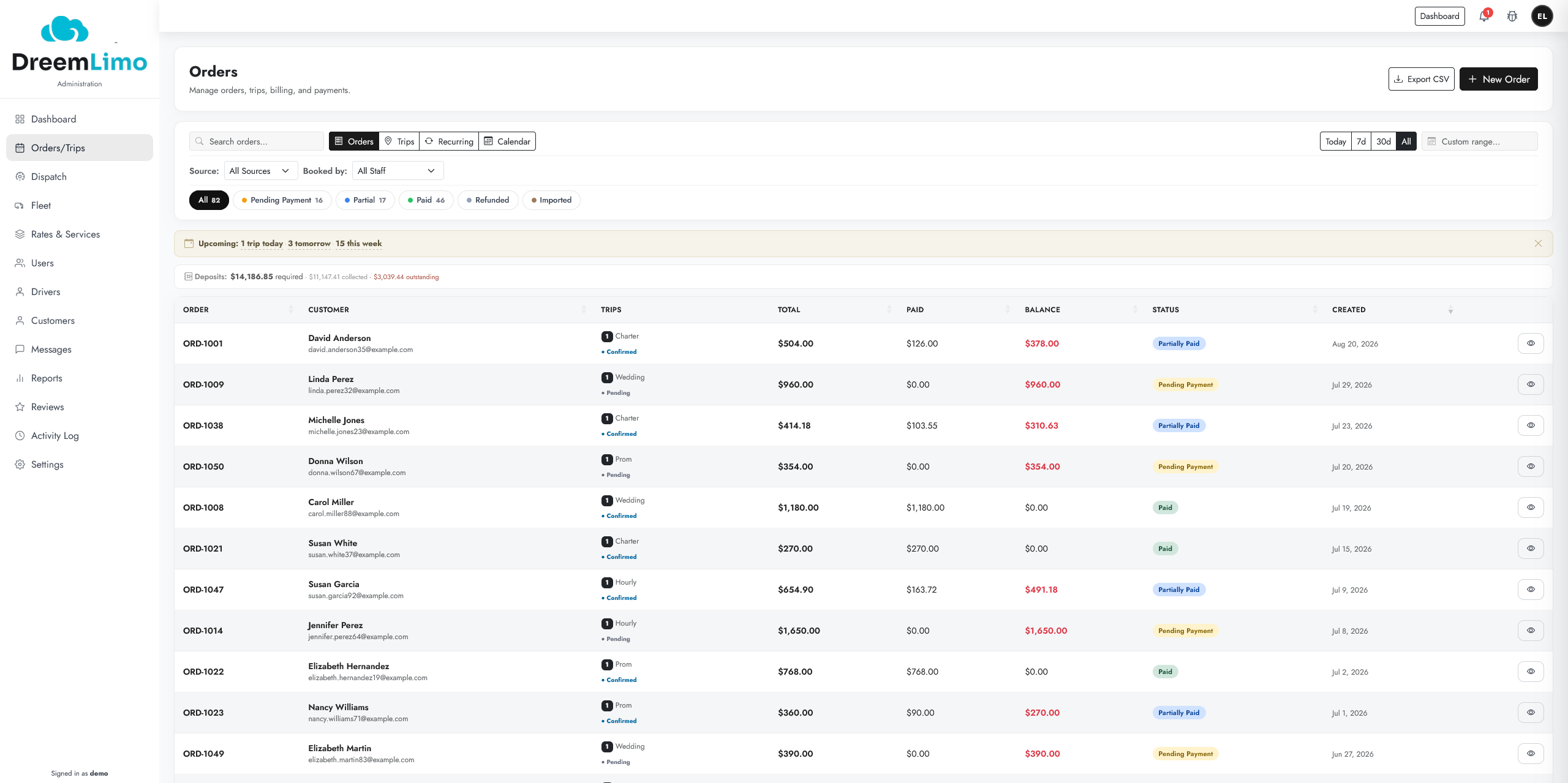
Fleets running 10 or more vehicles typically use limousine software that connects a corporate booking portal, a live dispatch board, automated driver notifications, and monthly account invoicing into one system. The result is that a travel coordinator at a law firm can book a 6:00 a.m. airport run at 11:00 p.m. without calling anyone.
Here are the core features that matter most for corporate accounts:
- Corporate account portal: A branded online booking page where a company’s travel coordinator logs in, books rides, and sees all upcoming trips in one place. No more email threads.
- Zone-based pricing: Flat-rate pricing by geographic zone (for example, ZIP code 90210 to LAX = $145) so quotes are instant and consistent, not negotiated each time.
- Dispatch board: A live view of all active and upcoming jobs, driver locations, and vehicle assignments. Cuts deadhead miles (empty miles driven to reach a pickup) by letting you assign the closest available vehicle.
- Automated driver push: The driver gets a job notification, accepts it, and the client gets a confirmation — all without the dispatcher touching a phone.
- Monthly account invoicing: Corporate clients often want a single invoice at the end of the month rather than paying per trip. Limousine software that supports account billing closes deals that a cash-per-ride setup cannot.
- Farm-out management: When your fleet is fully booked, farm-out tools let you pass the job to a trusted affiliate operator and track the margin. Farm-out means subcontracting a job to another licensed operator when your own vehicles are unavailable.
Our drivers handle roughly 60 percent more confirmed corporate pickups per week on jobs booked through the online portal versus phone bookings, because the portal captures card-on-file at the time of reservation and sends automated reminders 2 hours before pickup.
What Can You Do This Week Without New Software?
Even before you commit to a full limousine booking software platform, there are 4 concrete steps you can take this week to start capturing corporate accounts in the local area. None of them require a tech budget.
- Build a one-page corporate rate sheet. List your vehicle types, zone-based flat rates for the 5 most common airport runs in your area, and your hourly minimum (typically 2 to 3 hours for sedan, 3 to 4 hours for SUV or van). Send it as a PDF. A travel coordinator who gets a clear rate sheet in 10 minutes will remember you when the next booking comes up.
- Set up a dedicated corporate inquiry email. Something like corporate@yourdomain.com. Forward it to your phone. A separate address signals that you take business accounts seriously and makes it easier to track response times.
- Create a simple Google Form for ride requests. Ask for pickup date, time, location, destination, vehicle preference, and a credit card authorization checkbox. It is not a full booking system, but it captures the key details and creates a paper trail.
- Ask your top 3 current clients for a LinkedIn or Google review. Corporate travel buyers check reviews. A local operator with 40+ Google reviews and a 4.8-star rating wins over an unreviewed competitor nearly every time. Reviews and referrals are the primary sales channel for limo operators in markets like the local area, where word-of-mouth travels fast inside industry networks.
These steps will not replace a proper limo app or booking platform, but they move you from invisible to credible while you evaluate software options.
How Does Online Booking and Automation Change the Math for Corporate Travel?
When a corporate client can book online at any hour, confirm instantly, and receive automated reminders, your close rate on inbound leads typically climbs by 30 to 50 percent compared to a phone-only process. That is not a guarantee, but it reflects what operators consistently report after switching from manual dispatch to limousine booking software with an online portal.
The automation stack that moves the needle most for corporate travel programs includes:
- Instant online quotes: Zone-based or mileage-based pricing that generates a confirmed price without a call. As of 2026, most competitive limo apps in the local area market offer this as a standard feature.
- Automated confirmation and reminder texts: Sent to both the passenger and the booker. Reduces no-shows by up to 40 percent on corporate accounts, based on industry operator surveys.
- Driver tracking link: A live GPS link texted to the passenger 30 minutes before pickup. Corporate travelers expect this. It is table stakes against Uber Black.
- Account billing and reporting: Monthly statements that show every trip, vehicle used, and total spend. A CFO or office manager can reconcile this in minutes. This single feature often closes corporate contracts that a manual invoicing process cannot.
- ENERGY STAR-equivalent uptime standards: The best limousine software platforms target 99.9 percent uptime so your booking portal never goes dark during a busy booking window, like the 6-week holiday party season from mid-November through New Year’s Eve.
Seasonal demand matters here. Corporate travel peaks in Q1 (January board meetings and trade shows), dips slightly in summer, then surges again in Q4 for holiday events. Operators who have an automated system in place before November 1 capture the holiday party wave. Those still on phone dispatch lose jobs to whoever answers first.
Across our service calls in the local area, we see corporate account inquiries spike by roughly 3x between October 15 and November 15 compared to any other 30-day window in the year. Operators without an online booking option in place by mid-October routinely miss 8 to 12 bookable corporate events during that window alone.
Operators without an online booking option in place by mid-October routinely miss 8 to 12 bookable corporate events during that window alone.
Corporate account inquiries spike by roughly 3x between October 15 and November 15 compared to any other 30-day window in the year.
The U.S. Department of Energy notes that fleet efficiency and vehicle utilization directly affect operating margins for transportation businesses. Limo software corporate travel fleet managers use to manage dispatch reduces deadhead miles, which is one of the largest controllable costs in a black-car operation. Cutting deadhead by even 15 percent on a 5-vehicle fleet can save $4,000 to $8,000 per year in fuel and wear costs depending on local fuel prices.
It is also worth noting that federal transportation guidelines and local licensing requirements apply to commercial ground transportation in the local area. Operators running corporate accounts should confirm their vehicles and drivers meet all local permitting and insurance thresholds before marketing to business clients. Proper documentation is often a prerequisite for corporate travel manager approval.
For operators evaluating platforms, the ACCA (Air Conditioning Contractors of America) model of industry-standard operational benchmarks has a parallel in the ground transportation world: the best limo apps are built around verified dispatch workflows, not just pretty interfaces. Ask any software vendor how they handle double-booking conflicts and farm-out reconciliation before you sign a contract.
Get Your Corporate Travel Program Running in the Local Area
If corporate accounts are a growth target for your fleet, the window to get set up before the next booking wave is shorter than most operators expect. A new software platform typically takes 2 to 4 weeks to configure, test, and train your drivers on before it is ready for live corporate bookings.
Dreem Limo works directly with fleet operators in the local area to build out corporate-ready booking systems, including branded portals, zone pricing setup, and account billing. Whether you run 2 vehicles or 20, the platform scales to the volume you need without locking you into enterprise pricing you do not need yet.
Book a demo or launch your branded booking portal today. Call Dreem Limo to talk through your fleet setup, your current corporate account pipeline, and which features will move the needle fastest for your operation.
Frequently Asked Questions
What is limo software and do I really need it to land corporate accounts?
Limo software is a platform that handles online booking, dispatch, driver notifications, and invoicing in one place. Corporate travel buyers expect to book rides online at any hour and receive instant confirmation. Without it, you are competing against services that answer in seconds while you are still checking voicemail. In the local area market, operators with an online booking portal close corporate leads at a significantly higher rate than those relying on phone-only intake.
How much does limousine booking software typically cost for a small fleet?
In the regional market, limousine booking software for small fleets typically ranges from $100 to $500 per month depending on the number of vehicles, features included, and whether account billing is part of the package. Some platforms charge a per-booking fee instead of a flat monthly rate. The cost factors that move pricing up include branded portals, farm-out management, and monthly invoicing for corporate accounts. Contact Dreem Limo for a custom quote based on your fleet size and booking volume.
How do I get my first corporate travel account as a small limo operator?
Start by building a one-page corporate rate sheet with flat-rate pricing for your most common airport routes and a clear hourly minimum. Send it to local HR managers, executive assistants, and travel coordinators in your area. A professional rate sheet, a Google Business profile with 20 or more reviews, and a working online booking link are the three things corporate buyers check first. Dreem Limo can help you set up the booking infrastructure that makes your operation look corporate-ready from day one.
What is deadhead mileage and how does dispatch software reduce it?
Deadhead mileage is the distance your vehicle travels empty to reach a pickup — it burns fuel and adds wear without generating revenue. A live dispatch board in your limo software shows all driver locations and upcoming jobs so you can assign the closest available vehicle to each new booking. Operators who actively manage deadhead through dispatch software typically cut empty miles by 10 to 20 percent, which adds up to thousands of dollars in annual savings on a 3 to 5 vehicle fleet.
How does Dreem Limo help fleet managers in the local area set up corporate travel programs?
Dreem Limo works with operators in the local area to configure branded booking portals, set up zone-based pricing for common corporate routes, and enable monthly account billing for business clients. The platform is built to handle everything from a single airport transfer to a multi-vehicle corporate event without requiring a full-time dispatcher. Call Dreem Limo to walk through your current setup and identify the fastest path to your first corporate account.