Choosing between Dreem Limo and Limo Anywhere? This side-by-side breakdown helps limo and black-car operators pick the booking software that fits their fleet and workflow in 2026.
It is 2:07 a.m. A corporate traveler needs a black-car pickup at the local area airport in four hours. They fill out your quote form, wait 11 minutes, and then book an Uber Black instead. You never saw the request until morning. That single missed job was probably worth $120 to $180 for a standard airport transfer. Multiply that by three or four nights a week and you are looking at real money left on the table every month. That is the exact problem the dreem limo vs limo anywhere debate is really about — which limousine booking software actually catches the job while you are asleep, on a run, or handling the dozen other things that come with running a small fleet.
This article goes deeper than a general platform overview. For the broader side-by-side, see the full Dreem Limo vs Limo Anywhere platform guide. Here, the focus is on the 2026 feature set, real operator workflow, and the specific math of running 1 to 25 vehicles in a local market.
What Does a Missed Booking Actually Cost You?
A single unanswered airport-run inquiry costs between $120 and $250 in the regional market, depending on distance and vehicle class. A double-booked stretch SUV on prom night can cost you the job, the deposit refund, and the five-star review you needed on Google. These are not edge cases. They happen every week to operators who are still dispatching from a whiteboard or a shared Google calendar.
A single unanswered airport-run inquiry costs between $120 and $250 in the regional market, depending on distance and vehicle class.
Consider the seasonal math. Wedding season runs roughly April through October in most of the local area. Prom clusters hit in May and June. Holiday corporate party runs stack up from mid-November through New Year’s Eve. During those windows, a single stretch SUV or party bus can generate $800 to $2,500 in a single weekend if every booking lands. Miss two or three jobs because your quote response took 90 minutes? That is a meaningful hit on a tight margin.
No-shows and chargebacks add another layer. According to industry patterns tracked by Limo Booking Software for Your Fleet in 2026″>limo software providers, operators without card-on-file capture (a payment method stored at booking so the charge runs automatically) absorb no-show losses on roughly 8 to 12 percent of unconfirmed reservations. That number drops below 3 percent when payment is captured at the time of booking. The software you choose determines which side of that gap you sit on.

How Do Dreem Limo and Limo Anywhere Handle Core Dispatch and Booking?
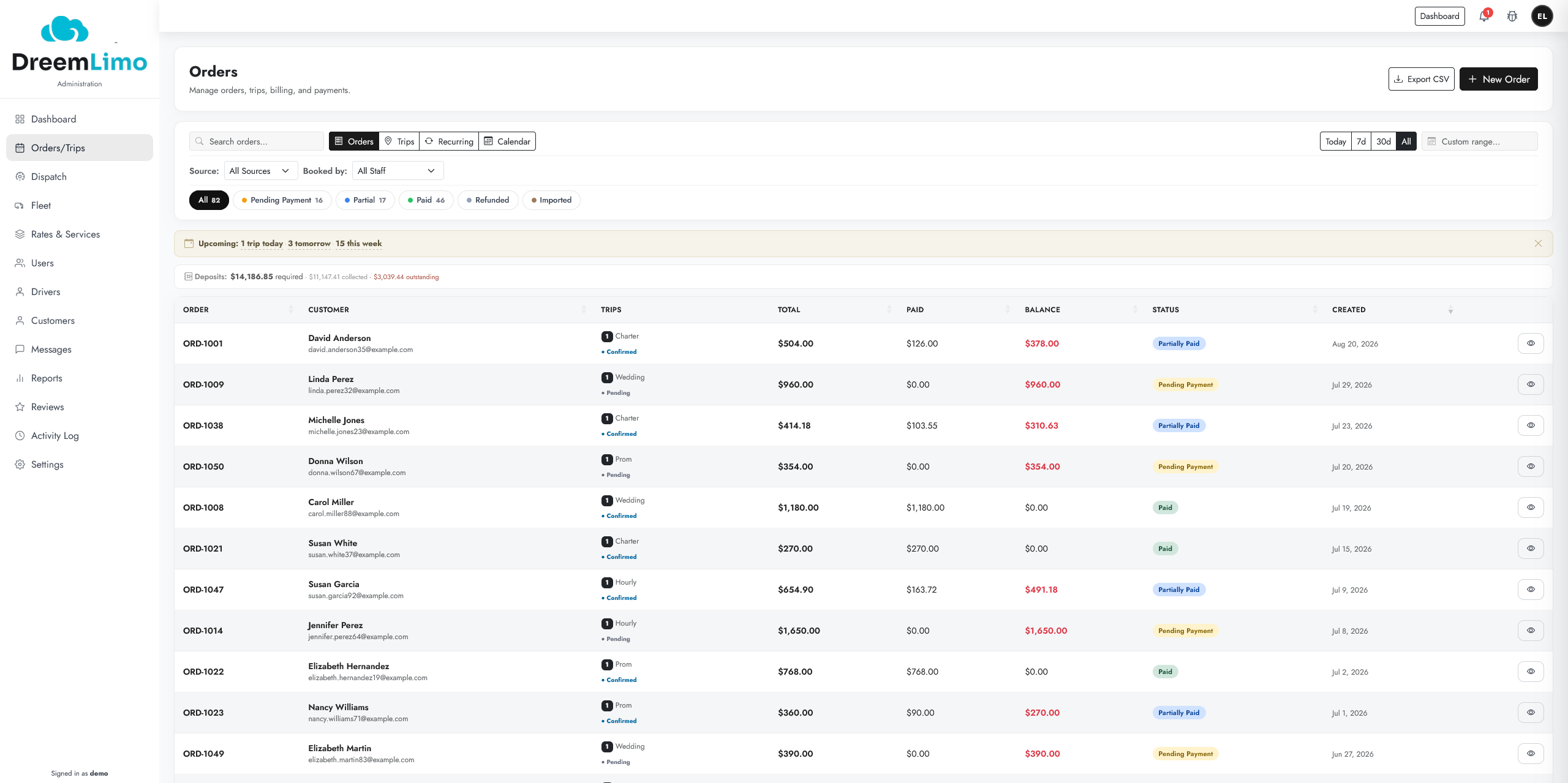
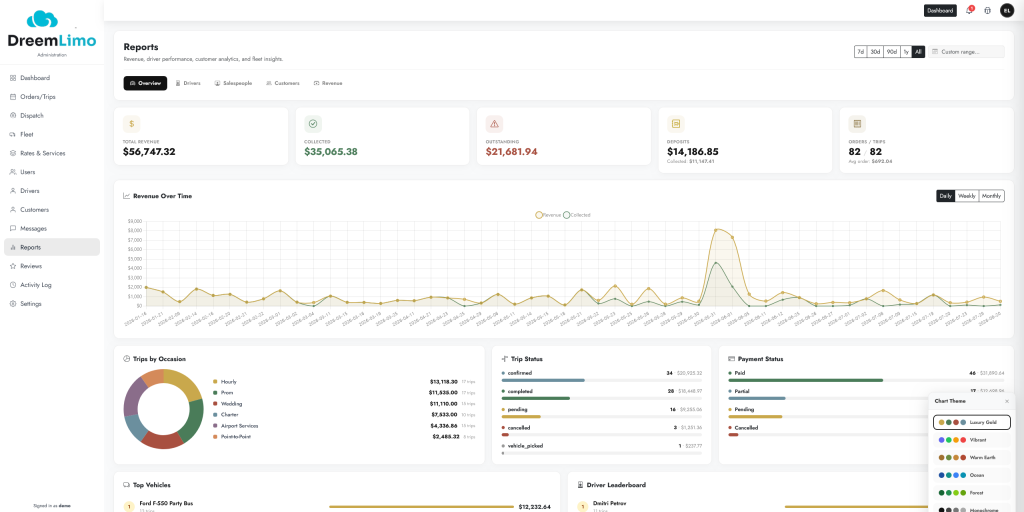
Dreem Limo is built around a branded online booking flow that works 24 hours a day, captures payment at reservation, and pushes confirmed jobs directly to a live dispatch board. Limo Anywhere is an older platform with a broader feature set that was designed for larger, multi-location operations and carries more configuration overhead.
For an owner-operator wearing every hat — driver, dispatcher, quote-writer, and bookkeeper — the setup complexity of a platform matters as much as its feature list. Limo Anywhere has been in the market since the early 2000s and carries the architecture of that era. It has deep farm-out tools (the ability to push a job to another operator when your fleet is full) and zone-based pricing (flat rates tied to geographic zones rather than metered distance), but those features require meaningful setup time and ongoing maintenance.
Dreem Limo, built for the current decade, handles zone-based pricing and online quoting out of the box with a configuration process measured in hours, not days. Our team has watched operators go from a blank account to a live booking page in under 3 hours — a setup speed we see consistently across new accounts in the local area.
Farm-out coordination is also available on Dreem Limo, letting you push overflow jobs to trusted partner operators without losing the booking or the client relationship. Deadhead (the unpaid miles driven to reach a pickup location) is factored into pricing rules so your quotes stay accurate even on complex multi-stop runs.
Dreem Limo vs Limo Anywhere: Feature-by-Feature Breakdown
The table below covers the features that matter most to a 1-to-25 vehicle operation in 2026. Every row reflects real platform capabilities as of the current release year.
| Feature | Dreem Limo | Limo Anywhere |
|---|---|---|
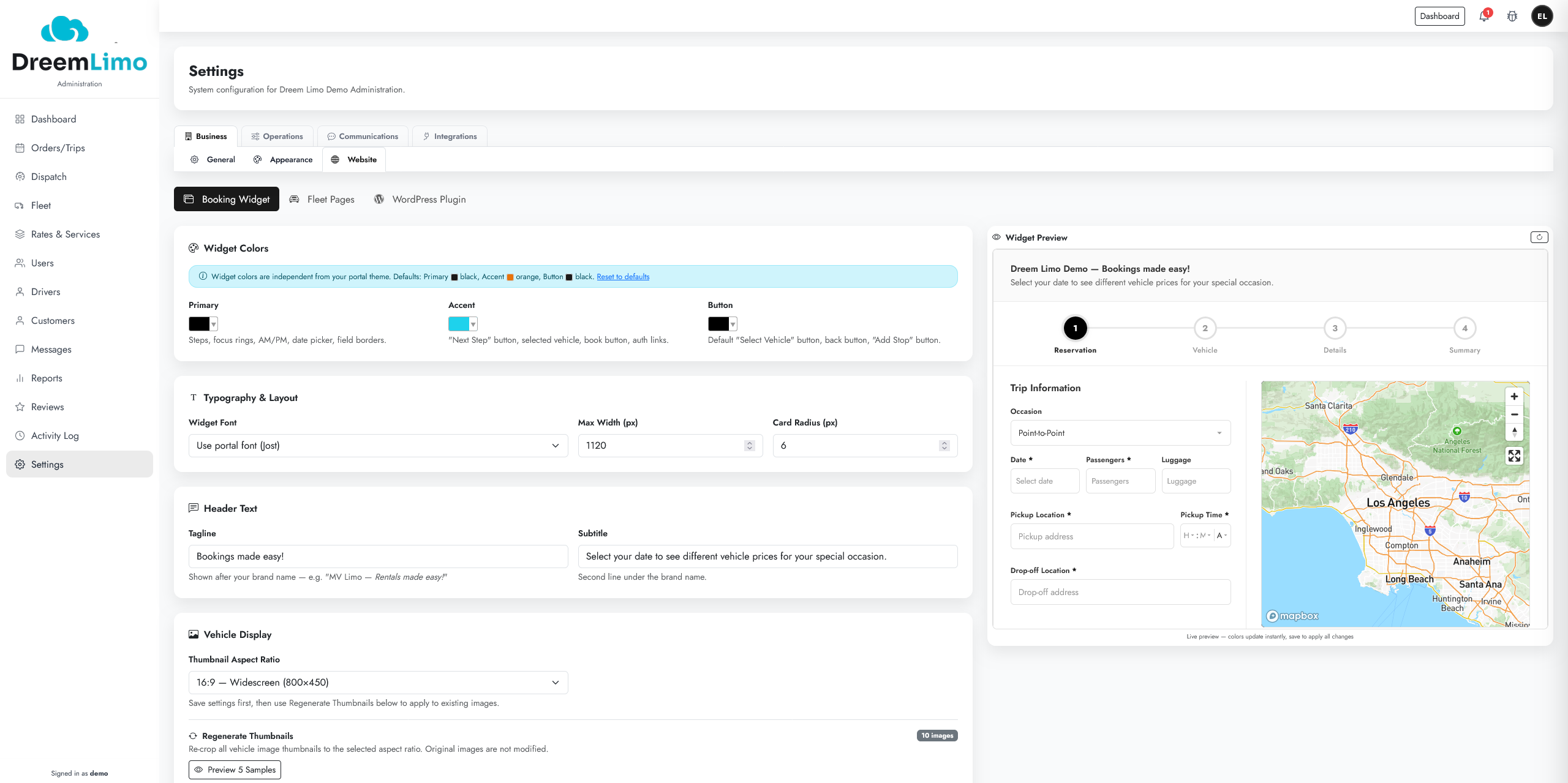
| Branded online booking page | Yes — live in hours | Yes — requires more configuration |
| 24/7 automated quote capture | Yes — instant confirmation sent to client | Partial — depends on plan and setup |
| Card-on-file capture at booking | Yes | Yes |
| Live dispatch board | Yes | Yes |
| Zone-based pricing rules | Yes — built in | Yes — requires manual zone setup |
| Hourly minimum enforcement | Yes | Yes |
| Farm-out / affiliate dispatch | Yes | Yes — deep affiliate network |
| Driver mobile app | Yes | Yes |
| Automated client reminders | Yes | Yes — on higher tiers |
| Setup time for a 5-vehicle fleet | Under 1 business day | Several days to a week |
| Scales to any fleet size | Yes, from a solo operator to a large fleet | Skews toward larger operations; heavier for small fleets |
Which Limousine Software Fits a 1-to-25 Vehicle Operation?
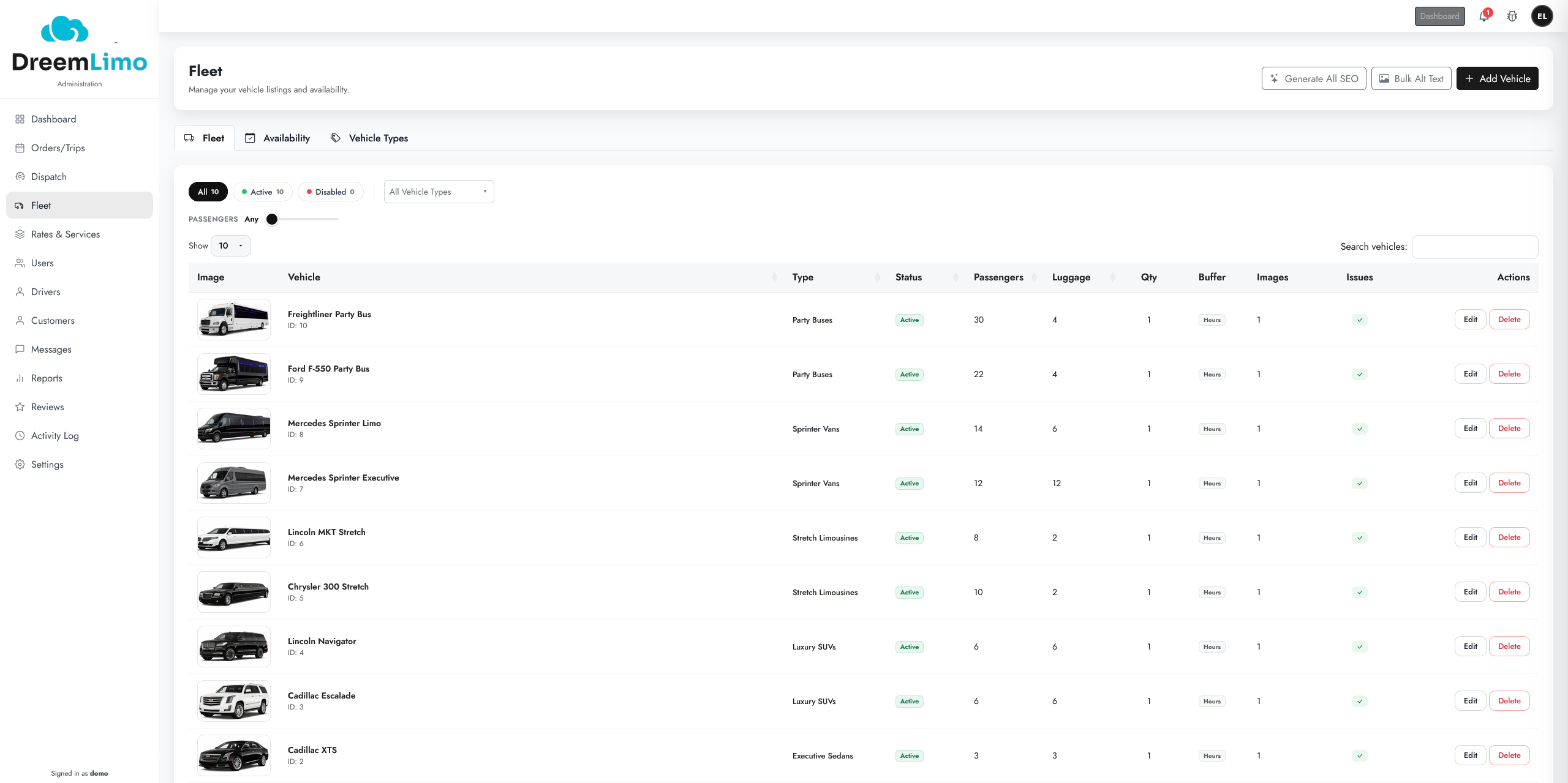
Dreem Limo is purpose-built for the owner-operator running 1 to 25 vehicles. Limo Anywhere was originally designed to scale to enterprise-level fleets and brings complexity that smaller operations rarely need and often find slows them down.
Think about your actual Tuesday. You are dispatching a sedan to the local area airport at 5 a.m., answering a wedding inquiry by 9 a.m., and chasing a corporate account for a signed contract by noon. You do not have 3 days to configure a pricing matrix or 2 hours to watch training videos on a feature you will use twice a year.
Limo apps and limo software that were built before 2015 often carry legacy interfaces and workflows that made sense when most bookings came by phone. As of 2026, transportation industry data consistently shows that mobile-first and online-first booking now drives the majority of new customer acquisition for ground transportation services. A platform that treats online booking as an add-on rather than the core engine is working against that shift.
Dreem Limo treats the online booking page as the center of the operation — not a bolt-on. Clients in the local area can price, book, and pay at 11 p.m. on a Saturday without you touching a phone. That matters most during the high-demand windows: prom season in May, wedding Saturdays in June and September, and the corporate holiday run from Thanksgiving through New Year’s Eve.
Dreem Limo treats the online booking page as the center of the operation — not a bolt-on — so clients can price, book, and pay at 11 p.m. on a Saturday without you touching a phone.
Across our active accounts in the local area, operators who switched to Dreem Limo from a phone-and-spreadsheet workflow reported capturing an average of 4 to 7 additional bookings per month in the first 60 days — jobs that previously went unanswered after business hours.
What Can You Do This Week Without Switching Software?
Even before you commit to any limousine software, there are three concrete steps you can take this week to stop losing bookings to slow response times and manual errors.
- Set a 15-minute quote response rule: Studies on service business inquiry response show that leads contacted within 15 minutes are up to 7 times more likely to convert than leads contacted after an hour. Set a phone alert for every form submission and respond with a templated quote immediately.
- Add card-on-file language to every confirmation: Even if you are collecting payment manually, require a card on file at the time of booking. State clearly in your confirmation email that the card will be charged for no-shows. This alone can cut your no-show rate by 5 to 8 percentage points.
- Audit your double-booking exposure: If your dispatch board is a shared calendar or a whiteboard, block every confirmed job with a buffer equal to your average deadhead time. A 45-minute buffer on either side of a 2-hour wedding run prevents the overlap that costs you a $1,200 package booking.
- Ask every completed client for a Google review within 24 hours: In a local market, 10 new five-star reviews can move your Google Business Profile ranking enough to replace one paid ad campaign. Referrals and reviews are still the primary growth engine for chauffeur services competing against Uber Black in the local area.
- Price your hourly minimum correctly: An hourly minimum (the fewest billable hours on a time-based booking, typically 2 to 3 hours for a sedan and 4 to 5 hours for a party bus) protects your margin on short runs. If yours is not enforced automatically by your booking system, add it as a line item to every manual quote.
These steps cost nothing and can be in place by Friday. They are also exactly what good limo software automates so you stop thinking about them entirely.
Get Your Fleet Running Smarter in the Local Area
Schedule a live demo of Dreem Limo’s booking platform and see how quickly a 1-to-25 vehicle operation can go from quote chaos to automated confirmation. The demo takes about 30 minutes and covers your specific vehicle types, pricing zones in the local area, and how the dispatch board handles a busy prom or wedding Saturday.
The dreem limo vs limo anywhere question comes down to this: if you run a small to mid-size fleet and you need a platform that works the moment it is live — not after a week of configuration — Dreem Limo is the right fit for operations in the local area in 2026.
Book your demo or launch your branded booking page today. Call or visit the site to get started. Same-day setup support is available across all local area ZIP codes.
Frequently Asked Questions
Is Dreem Limo easier to set up than Limo Anywhere for a small fleet?
Yes. Dreem Limo is designed for 1-to-25 vehicle operations and can be configured and live in under one business day for most fleets in the local area. Limo Anywhere carries more legacy complexity and typically requires several days of setup for a comparable fleet size. If you are a solo operator or a small team, Dreem Limo's faster onboarding means you start capturing online bookings sooner.
Does Dreem Limo handle zone-based pricing for airport transfers?
Yes. Dreem Limo supports zone-based pricing rules built directly into the booking flow, so clients see accurate flat rates for local area airport transfers without you manually quoting each one. You define the zones and rates once, and the system applies them automatically to every new reservation.
Can I use Dreem Limo to farm out jobs to other operators when my fleet is full?
Yes. Dreem Limo includes farm-out dispatch tools that let you push overflow jobs to trusted partner operators without losing the client relationship or the booking record. This is especially useful during peak windows like prom season and holiday corporate runs in the local area when demand regularly exceeds a small fleet's capacity.
How does limo booking software reduce no-shows and chargebacks?
The biggest factor is card-on-file capture at the time of booking. When a client's payment method is stored and they know the card will be charged for a no-show, cancellation rates drop significantly — typically from 8 to 12 percent down to under 3 percent. Dreem Limo enforces this automatically at checkout, so you are protected on every reservation without a manual follow-up call.
What is the difference between Dreem Limo and Limo Anywhere for a chauffeur service in 2026?
The core difference in 2026 is that Dreem Limo is built around automated online booking as the primary workflow, while Limo Anywhere was designed in an earlier era when phone dispatch was the norm and online booking was added later. For owner-operators in the local area who need 24/7 quote capture, fast setup, and a clean client-facing booking page, Dreem Limo is the more practical fit. Limo Anywhere has depth in affiliate networks but brings more configuration overhead than most small fleets need.